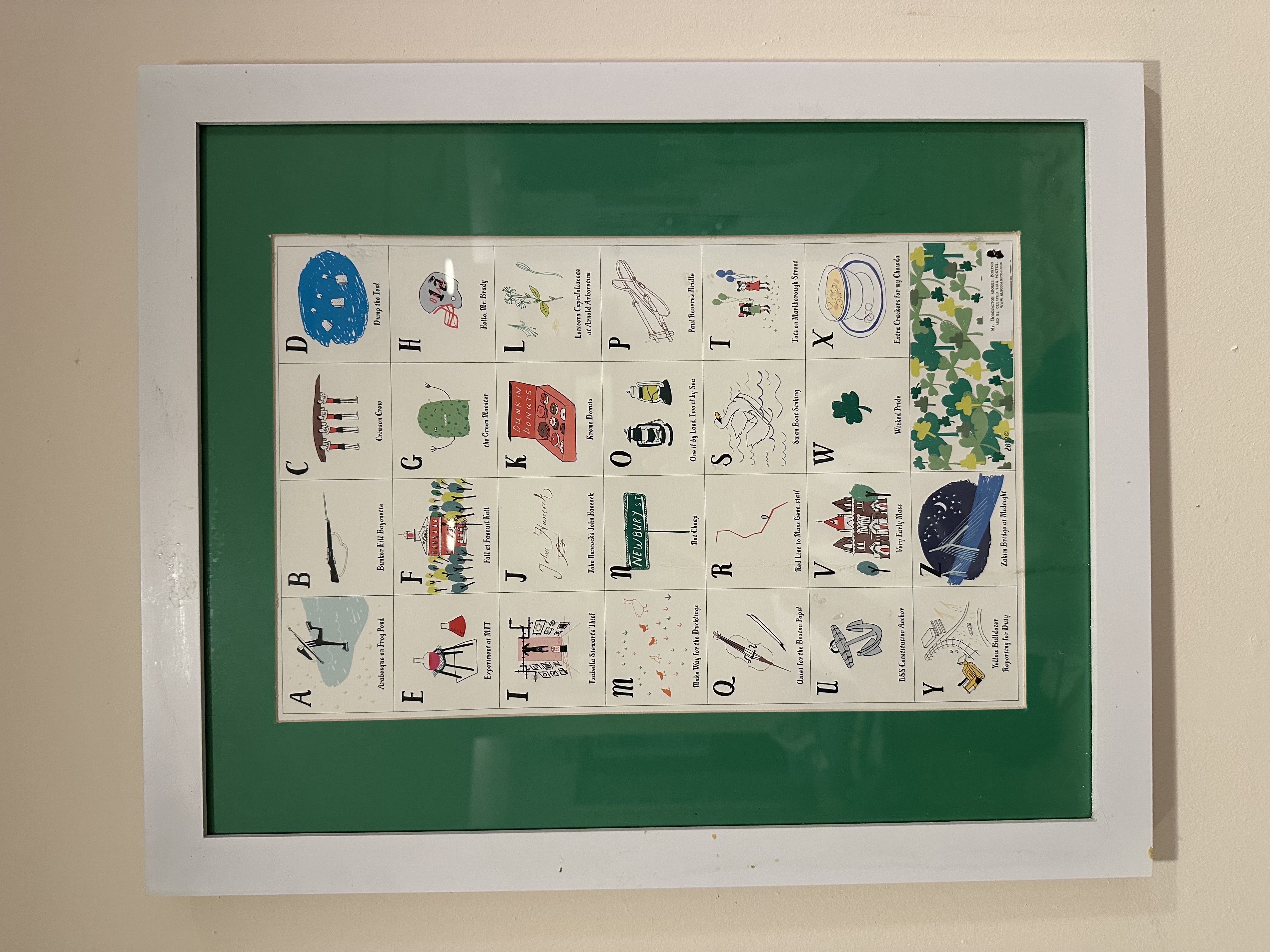
The latest addition to our home came already framed: a Boston alphabet, full of tiny local jokes and familiar places, surrounded by a generous green mat and a white frame that has plainly seen some life. Which, really, is part of the point.
We found it through our local Buy Nothing group. Someone had something worth enjoying and offered it to a neighbor. We happened to be the neighbors who brought it home.
It's not just the sort of thing I would happily admire in a shop. It's the sort of thing that makes a room feel like the people who live there actually live there.
A little Boston, letter by letter.
There is a joke tucked into nearly every square. A is for Arabesque on Frog Pond—which sent us straight back to our own Boston Common Frog Pond guide. F is for Fall at Faneuil Hall. The small details are what make the artwork so charming: familiar places, little bits of local history, and the kind of Boston humor you notice more on a second look.
That this print came to us through a neighbor makes us treasure it all the more.
To me, that's good Yankee frugality. Not refusing to enjoy beautiful things. Not turning household life into a competition to spend the least. It's appreciating what's already here, knowing the difference between price and value, and being delighted when a useful or lovely thing finds the right person.
The best things in a home are not always the things we went shopping for.
The joy of receiving matters, too.
We talk about the pleasure of giving, and rightly so. But Buy Nothing communities ask us to be comfortable on both sides of the exchange.
One week, perhaps you are the person with a lamp to spare. Another week, you are the person who could really use one. A borrowed folding table, a box of books, an extra frame, a garden tool you only need twice: these things don't have to sit in a cupboard waiting to be useful someday.
And neither does kindness have to be a grand gesture. It can be a simple message, a good photograph of the item, a cheerful pickup, and an uncomplicated thank-you.
There's dignity in being able to ask. And there's something heartening about a community where a person who receives today is never expected to justify their need or become a charity project.
Because ordinary life has an extraordinary bill.
Most families know the arithmetic of daily life: groceries, housing, school supplies, the car, the utility bill that arrived at an especially inconvenient moment. For many disabled people and families caring for disabled relatives, there can be another layer—medical bills, therapy, adaptive equipment, transportation, appointments, and the work hours that become difficult to keep.
A free household item will not fix those larger pressures. Nor should neighborly generosity be used as an excuse for systems that fail to provide people with what they need. But it can ease one small expense, save one trip, or simply make an ordinary Tuesday a little nicer.
And everyone belongs in these groups—not only people who are struggling financially. When households with different resources all give and receive freely, the exchange becomes a way of living together rather than a label about who needs help.
It can mean choosing a beautiful framed print while keeping money for a medical bill, a family outing, the occasional good meal, or whatever makes a particular household's life work. No one should have to choose between necessity and every bit of everyday pleasure.
A rather good version of the American life.
We often talk about the good American life as something we acquire: the right house, the right furnishings, the right things inside it. I think there's another version worth holding on to. It's a home that feels welcoming, enough time with the people you love, a little freedom from waste and worry, and neighbors who remember that we need one another.
It feels very New England to me, with the practical affection for old things, shared tools, and a sturdy frame. But the idea belongs everywhere. Every town could use a few more people willing to pass something along.
There is a conservation story here, too. Reuse is not quite the same as recycling: it means keeping a perfectly serviceable thing in use rather than processing its materials. Connecticut’s Department of Energy and Environmental Protection explains the distinction. One picture changing walls will not save the planet, but it belongs to a habit that keeps good things in circulation.
So here is to the generous neighbor, the well-used swap shed, the free book left for the next reader, and the perfectly good thing that doesn't need another trip to the store.
And here's to our Boston alphabet, a lovely little reminder that value and price were never synonyms in the first place.
The letter is personal; the guide below is practical. You'll find verified links to free-sharing groups and town reuse programs throughout New England.