New England family life · Beautiful, useful & lived in
An AUsome Life

Communication · AAC · Access

Communication is an ecosystem, not a device.

Speech, an AAC app, a look toward the door, a sign, a photograph, a typed sentence, a switch, a sound, a paper board or an established yes/no signal can all be part of one person’s communication. The goal is not to force one “best” mode. It is to make enough reliable routes available that the person can say what they mean, where they are, with the body and energy they have that day.

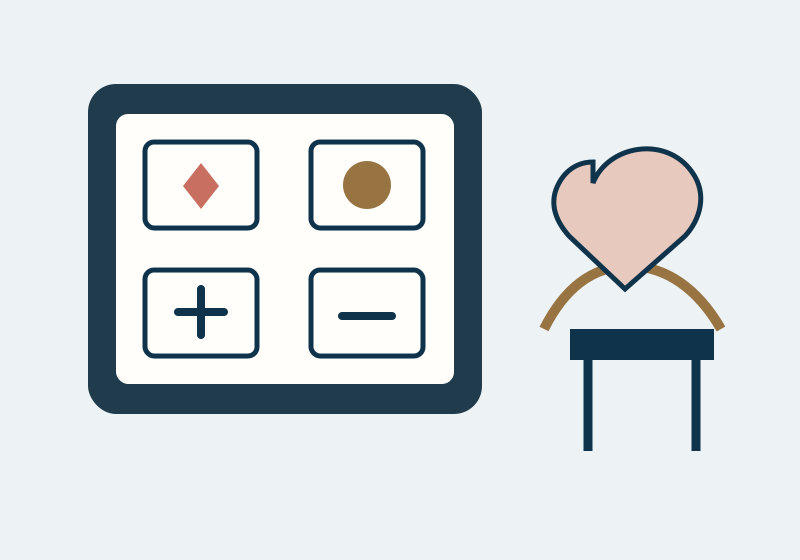
Illustration of a communication tablet with choice symbols beside a quiet bench.
One visual route is useful. A whole communication system includes the person, their access method, their language, their partners, and a backup when the first route is not workable.
No prerequisitesASHA guidance says AAC should not be withheld because of age or presumed cognitive, language or motor prerequisites.
More than requestingA full system needs room for refusal, opinions, jokes, questions, repair, social closeness and sharing information—not only “I want.”
Always availableCommunication tools should stay accessible across settings, including low-tech backups when electronics are impractical.

Evidence and links checked October 2, 2026. This is practical family guidance, not an individualized AAC evaluation.

01 / Multimodal by design

Use every reliable route. Do not make speech the tollbooth.

ASHA describes AAC as inherently multimodal: a person may combine speech or vocalizations with gestures, signs, facial expression, objects, pictures, photographs, writing, spelling, communication boards, text-to-speech and speech-generating devices. The mix can change by place, communication partner, motor access, fatigue, sensory load and message.

Speech + vocalization

Words, approximations, sounds, intonation, laughter and other intentional vocal signals.

Gesture + sign

Pointing, reaching, conventional gestures, manual signs, body orientation and established movements.

Symbols + pictures

Photographs, visual scenes, communication books, symbol grids and meaningful objects.

Writing + spelling

Handwriting, typing, texting, alphabet boards and text-to-speech when independently accessed.

Eye gaze + scanning

Direct eye-gaze selection, switches, auditory or visual scanning, and partner-assisted scanning.

Speech-generating tech

Dedicated devices, tablets or phones with robust symbol- or text-based language systems.

A useful distinction: message vs. route

“I need a break” is the message. Speech, pressing a symbol, looking to a “break” card, signing, pointing to the door or selecting “yes” during partner-assisted scanning are possible routes. When one route becomes hard, the message still deserves another route.

Behavior can carry information. It is not a mind-reading system.

A change in movement, pacing, vocalization or facial expression may tell a familiar partner that something is different. Respond to the person and the situation, but do not assign a precise message without a way to confirm it. “You seem uncomfortable. Is something wrong?” plus an accessible way to answer protects agency better than deciding what the behavior “means.”

Visual example: a tiny backup board

This is deliberately small: it is the sort of emergency board that might live in a pool bag or glove compartment. It is not a substitute for a person’s full vocabulary.

ASHA’s 2026 AAC Awareness Month materials specifically highlight public communication boards as useful low-tech access in places such as libraries and parks. A public board is an additional route—not a reason to leave someone’s personal AAC behind.
02 / Access is part of language

The same vocabulary can be reached in very different ways.

Touch is only one access method. ASHA describes direct selection through touch, joystick, eye gaze, head mouse, trackball or other signals, and indirect selection through scanning. In partner-assisted scanning, the partner presents choices in an agreed sequence and the communicator makes the selection with an established independent signal such as a look, blink, movement, sound or switch.

Direct touch

Useful when target size, motor planning and positioning make touch reliable. Do not shrink buttons simply to fit more vocabulary.

Eye gaze

Can be low-tech with an eye-gaze frame or high-tech with a camera-based system. Calibration, positioning, lighting and visual access matter.

Switch + scanning

Items are highlighted or spoken in sequence; the user activates a switch or signal when the desired item appears.

Partner-assisted scanning

Low-tech and powerful when the person has a dependable selection signal. The partner presents; the communicator selects.

Keyboard / text

Typing can be paired with word prediction, stored phrases or text-to-speech to reduce effort while preserving authorship.

Multiple access methods

A person may touch at a table, use partner-assisted scanning in a pool, and use eye gaze when motor fatigue makes direct touch unreliable.

Access changes. That does not mean the person has “lost” communication.

Before deciding a system is not working, check positioning, target size, sensory conditions, fatigue, vision, hearing, device volume, charging, vocabulary location, partner familiarity and whether the person has a lower-effort alternative.

Screen time is not the right frame for communication.

ASHA explicitly notes that concerns about ordinary recreational screen time do not apply to screens used as part of an AAC system. A communication device is access to language.

03 / Partner skill

The people around AAC are part of the system too.

A sophisticated device with rushed or controlling partners can still produce very little real communication. Communication-partner instruction has a research base, and common strategies include aided modeling, expectant delay, responsive interaction and practice across everyday settings.

Model, do not quiz.Use the person’s AAC while you talk, especially for words beyond requesting. Show language without demanding imitation.
Wait longer than feels natural.Looking, navigating, motor planning and composing a message can take time. Do not fill every silence.
Respond to every credible attempt.A gesture, device selection, word, look or sign deserves a response even when the answer to the request is no.
Talk to the person.Ask the AAC user the question. A support person can help with access without becoming the person being addressed.
Leave room for “no.”A communication system that can only produce compliance is not a full communication system.
Repair together.Try “I think I missed that. Can we try another way?” rather than pretending to understand.

Model a wide range of reasons to communicate.

refuseaskcommentjoketell newscomplainflirtask for helpsay “not that”talk about painchange the subjectend the conversation

Presume a right to communicate, not a message you have already decided.

Respecting competence means offering meaningful language, access and time. It does not mean claiming to know what someone intended before they have a reliable way to indicate it.

04 / In ordinary life

Build redundancy before the hard moment.

A multimodal plan is most useful when it answers a simple question: What can this person use here, right now, if their usual route is difficult?

Pool

Electronics and water do not mix.

Keep the primary device available in a safe dry place, and add a waterproof or laminated board for words such as stop, more, out, bathroom, cold, help, finished and something else. Decide how yes/no will work in the water.

Restaurant

Menus create extra language demands.

Use the person’s robust AAC, a photo or actual menu, pointing, text, or a short choice display. Keep “none of these,” “something else,” “not hungry,” and comments available—not only food requests.

School / program

Consistency matters more than identical behavior.

Keep the same core language available across rooms and staff. A printed backup, charging plan, access instructions and a short communication passport reduce the risk that AAC disappears when one adult is absent.

Medical visit

Do not let the historian replace the patient.

Ask the person first when possible. Prepare vocabulary for location, intensity, yes/no/not sure, body parts, fear, stop, explain again and “I need a break.” A familiar supporter can clarify access and history without answering everything by default.

High stress

Language may need a lower-effort route.

Keep a small, predictable set for urgent messages—stop, break, help, pain, bathroom, home, not that, yes/no—while preserving access to the full system when the person wants it.

With unfamiliar people

Make the rules visible.

A one-sentence note can say: “Please speak directly to me, wait for my answer, and do not move my communication system without asking.”

Before leaving the house

05 / What is genuinely new

AI can reduce effort. It should not become the author.

Current AAC research is exploring smarter prediction, personalized vocabulary, expressive synthetic speech, emotion-related features and new access methods. The useful test is not “does it look futuristic?” but “does it increase speed, independence, precision or participation without taking control of the message?”

Useful now

Prediction + stored language

Word prediction, phrase prediction and well-chosen stored messages can reduce keystrokes. A 2025 AAC study explored partner-suggested vocabulary in a dual-tablet system as a way to increase efficiency. Suggestions should remain suggestions: the communicator accepts, rejects or changes them.

Emerging

AI-assisted expression

A 2026 preliminary study explored AI-based emotion recognition as one possible AAC feature. Interesting is not the same as settled. An algorithm’s guess about emotion should never be treated as the person’s statement of how they feel.

Research frontier

Brain-computer interfaces

BCI research is advancing for people with severe motor impairment, including communication applications. 2026 reviews describe promise but also major variability, usability, training and ethics questions. It remains an emerging access route, not a general replacement for established AAC.

Privacy deserves a place in the setup.

AAC can contain extremely personal language: health information, relationships, location, private conversations and custom vocabulary. When a system adds cloud prediction or AI features, check what is uploaded, stored, used for model improvement, synced across devices or visible to support staff. Convenience should not quietly erase communication privacy.

A good AI rule for AAC

AI may help find, predict, pronounce or organize a message. It should not decide the person’s meaning. Keep the final selection under the communicator’s control and make generated suggestions easy to reject.

06 / Authorship matters

Support access without confusing the supporter with the author.

Some communication methods involve another person, so the key question is who is selecting the message. Partner-assisted scanning can preserve authorship when the partner presents options and the communicator makes each selection using an established independent signal.

Letterboards are not all the same thing.

A letterboard or alphabet board can be ordinary low-tech AAC when the person independently points, looks or otherwise selects letters. That is different from methods in which a facilitator physically guides, steadies or cues the person in a way that may determine the selection.

What major professional guidance says

ASHA identifies Facilitated Communication (FC) as discredited and says it should not be used because controlled research has shown facilitator authorship. ASHA also does not recommend Rapid Prompting Method (RPM), including Spelling to Communicate (S2C), because of prompt-dependency and lack of scientific validity; messages produced through these methods should not simply be assumed to be authored by the disabled person. That concern is about authorship and evidence—not about denying nonspeaking people access to spelling, literacy or robust AAC.

Questions that protect authorship

  • Can the person make the selection without another person touching or directing their hand, arm or board?
  • Is the person’s selection signal defined and observable?
  • Can unfamiliar or differently positioned partners obtain the same kind of response?
  • Can the person disagree with the partner, choose unexpected vocabulary and initiate a topic?
  • If the message has serious consequences, is there a way to verify authorship without leading the answer?

07 / Copy + print

A one-page multimodal communication profile

Keep this practical. It should help an unfamiliar person communicate better in the next ten minutes—not summarize someone’s life.

My communication routes

One more line worth adding

“If you are not sure what I meant, please tell me. Give me another way to try.” Communication repair is a skill shared by both people in the conversation.

Sources + further reading

Where this guide is grounded.

ASHA Practice Portal: Augmentative and Alternative Communication
Clinical overview of multimodal AAC, access methods, selection techniques, intervention and ongoing system adaptation.

National Joint Committee: Communication Bill of Rights, 3rd edition
Rights-based guidance on dignity, direct communication, participation, refusal and access to individualized working AAC across settings.

ASHA, October 2026: Communication Boards Impact Communities
Current AAC Awareness Month guidance on low-tech communication boards in public places.

AssistiveWare: Communication partner skills
Practical modeling, waiting, responding and making robust AAC available.

Kent-Walsh et al.: Communication partner instruction meta-analysis
Evidence supporting partner instruction strategies for people who use AAC.

Smart Predict (Augmentative and Alternative Communication, 2025)
Research on partner-suggested vocabulary and conversational efficiency.

AI and emotion expression in AAC (AJSLP, 2026)
A preliminary study—useful for understanding what is emerging, not as settled practice.

Individualized brain-computer interface for people with disabilities (2026 review)
Current state of BCI-based assistive and communication technology, including limitations and ethics.

ASHA: Facilitated Communication · ASHA: Rapid Prompting Method
Professional position statements on message authorship and facilitator-dependent methods.

The research base changes. Technology descriptions here are deliberately separated into established practice, emerging tools and research-frontier approaches.