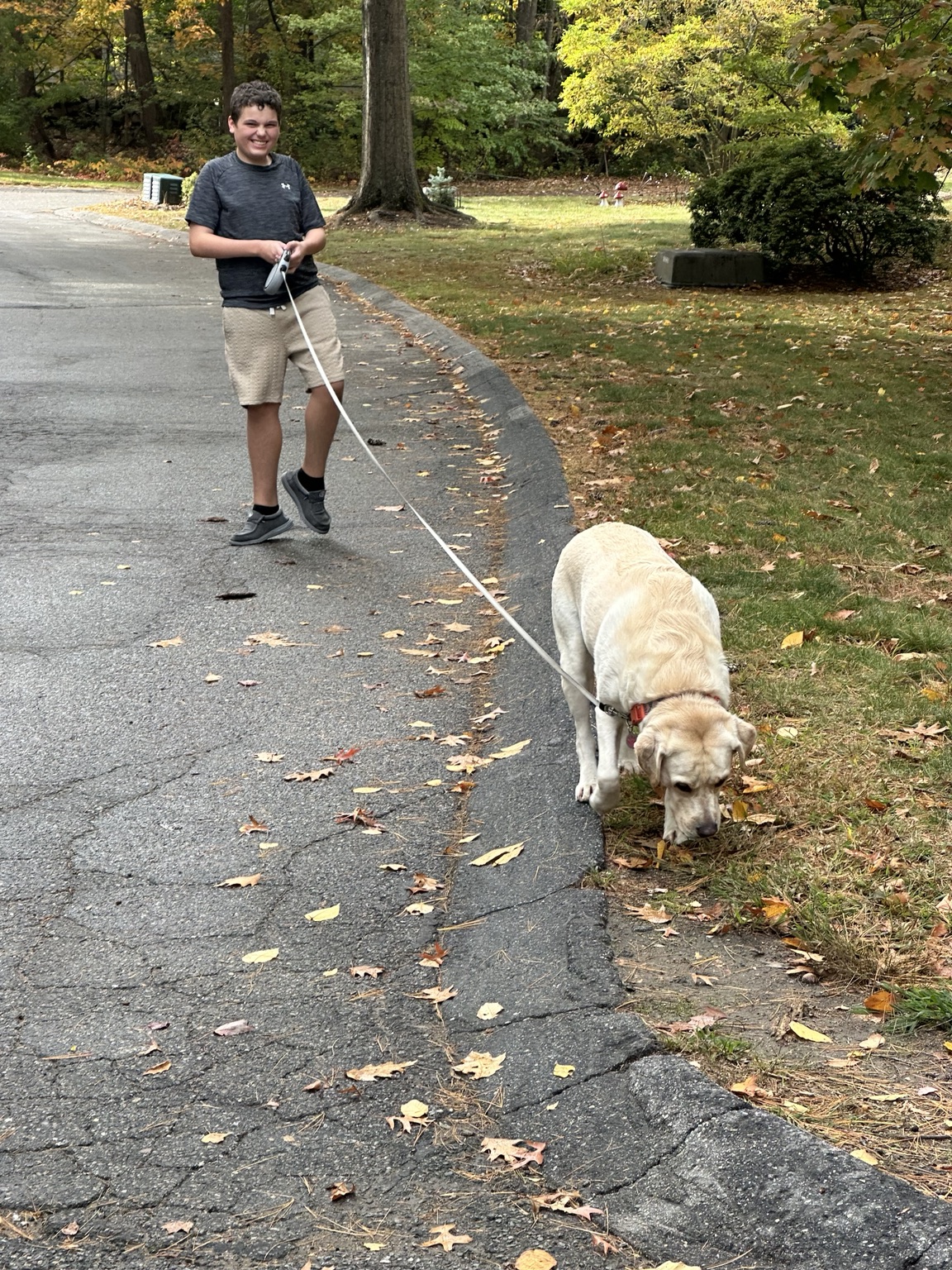
James, a very busy yellow Lab, and the pleasure of an ordinary autumn visit with Mom-Mom and Grandpa Steve.
· Family story & practical nature guide
James and Ruby, with autumn underfoot. From our family camera roll.
James has the leash and a big grin. Ruby has her nose in the grass and apparently quite a lot to investigate. There are leaves scattered along the road, yellow beginning to show in the trees, and still enough warmth for shorts. A very New England sort of autumn.
I love this photograph. James is looking up at the camera while Ruby gets on with the important business of being a dog. The leash makes a long white line between them. Around them, the season is quietly changing.
A visit with Mom-Mom & Grandpa Steve (aka Grandma & Grandpa), a little time outside, and Ruby to walk. James is right in the middle of it all. It’s a simple way to spend the afternoon together.
Autumn in New England gives us so much to look at on an everyday walk. Green leaves hang on beside the gold ones. A few have already landed at the edge of the pavement. I like this part of the season, when summer is still showing up in somebody’s outfit and the trees have begun moving on.
And then there is Ruby, who seems perfectly prepared to spend the afternoon examining one small patch of grass. She makes a good case for taking our time. There may be something very interesting by the next leaf.
There is so much texture in this picture: the rough edge of the road, the soft-looking grass, Ruby’s pale coat against the dark pavement. It makes me think about how many ways there are to meet a season. Looking is one. Listening, feeling the air, or simply spending a few minutes in a familiar place are others. Nobody needs to notice the same thing.
What I want for James is room to be part of the day in his own way. A good afternoon doesn’t need a mileage goal, a completed activity, or a photograph in which everybody faces the camera. It can have pauses. It can change direction. It can end while there is still something left to see.
These are the family photographs I keep coming back to: James smiling, Ruby nearby, and time with Mom-Mom and Grandpa Steve. A walk together belongs in the family album just as much as a holiday or a birthday.
A dog, some leaves, and time with the grandparents. The simple joys of autumn, right here.
If you’re planning some time outside this autumn, here are some ways to begin. A bench, a smooth path, a garden, a window overlooking a tree: there is more than one good way outside.
The practical field guide · New England
A little nature, your way.
A sensory walk can be a sit, a roll, or a few minutes at the doorstep. Choose what feels interesting and comfortable today; every suggestion is optional.
01 · Make room for everyone
Choose the outing that fits today.
Universal design starts with choices built into the plan: a usable route, somewhere to rest, information in more than one form, and an easy way to finish. These ideas are for children, teens, and adults, with and without disabilities. Choose by preferences and support needs, not an ability ranking.
Stay in one lovely spot
Try five minutes beside a tree, at a garden table, or on an accessible viewing deck. A seated companion can share the same view. On a home day, watch branches from a window or enjoy a familiar nature photograph together.
Go a little way & return
Pick a firm route with a known turnaround: the first bench or one tree. Check the distance both ways. Walking, using a wheelchair or walker, and bringing a stroller are all ways to enjoy the same small outing.
Leave room to explore
If everyone wants more, add another section after checking its surface and slope. Keep the shorter plan available. More distance is an option, never the measure of a good day.
02 · An invitation, never a checklist
Eight ways to meet the season.
Start with one appealing idea. Keep it, change it, or skip it. A quiet setting for one person may feel busy to another; there is no need to use every sense or turn the afternoon into a lesson.
01 Sight
Notice one gold leaf, a cloud, or a reflection from a comfortable position. Bring a leaf into view only where handling is permitted; a companion can describe its shape and color.
Make it gentler: Try shade, a brimmed hat, or a still view instead of sparkling water. Looking away is fine.
02 Sound
Pause for wind in the trees, a bird, or leaves underfoot. If listening is not useful or enjoyable, watch branches sway or notice a bird’s movement instead.
Make it gentler: Use preferred hearing protection and move away from roads, leaf blowers, barking, or crowds. No “quiet listening” performance required.
03 Touch
Offer a permitted tactile exhibit or a familiar leaf from home on a tray within comfortable reach. Touch with a fingertip, through a glove, or not at all. Do not place objects in someone’s hand without agreement.
Make it gentler: A favorite fabric or fidget can come along. Leave unfamiliar plants, fungi, and wildlife untouched.
04 Smell
Notice the air near a pine grove, a garden, or the shore from the path. Let the person choose the distance; there is no need to pick, crush, or bring plants close to a face.
Make it gentler: Skip scent activities around allergies, nausea, or aversion. Move away from strong smells; bring no added fragrance.
05 Taste
Have a familiar snack or drink at a comfortable stopping place. An autumn picnic can mean the food someone already enjoys; trying a new flavor is entirely optional.
Make it work: Follow the person’s usual eating and drinking supports. A non-food pause is equally welcome. Do not taste wild berries, mushrooms, leaves, or water.
06 Movement & balance (vestibular sense)
Choose a short, smooth stretch at the person’s preferred speed, or stay still and watch the scenery. A turn or change in pace should be expected and agreed on.
Make it gentler: Avoid surprise pushing, spinning, steep slopes, and uneven shortcuts. A stable seated position is a full way to participate.
07 Body position & effort (proprioception)
Notice comfortable contact with a seat, backrest, or foot support. If already comfortable and chosen, carrying a light water bottle or moving along the path can offer another way to notice effort.
Make it gentler: No added weights, forced stretches, or endurance goals. Rest and familiar positioning supports belong on the outing.
08 Inside-body cues (interoception)
Offer a concrete choice: “drink or rest?” “jacket on or off?” Check comfort, temperature, energy, and toilet needs without requiring anyone to name a body sensation.
Make it easier: Offer planned breaks and usual supports even without a request. Pause or leave when discomfort appears.
03 · Six states, a few good starting points
Where might you begin?
These are researched planning ideas, not reports that our family has visited every location or audited access. Official information was checked October 14, 2026. Follow the links for current conditions, fees, and facilities; an “accessible” trail label does not describe every person’s experience.
MassachusettsDrumlin Farm · Lincoln
A small start: The 350-foot Ice Pond Trail offers a woodland-and-pond outing, with a guide rope, Braille stops, and an audio tour. The surface is crushed stone and the path is five feet wide.
Check the fit: Mass Audubon notes that portions can still feel steep or strenuous. Accessible restrooms and equipment loans are listed; confirm availability. The farmyard adds animal sounds, smells, and visitors.
With a dog? Pet dogs are not permitted; service animals are welcome.
A small start: Ask staff about an accessible approach to a seaside picnic spot, or a short section of the paved recreation path along Route 1A. Try watching waves or noticing the sea air.
Check the fit: The roadside route may bring traffic noise; natural-surface trails are different terrain. The park currently flags dune-restoration trail closures. Confirm the exact route, gate access, and seasonal restroom opening before setting out.
A small start: The White Pines Trail is identified as accessible in Maine’s park access guide. Begin at the second parking lot and choose a short out-and-back among the pines toward the bay views.
Check the fit: Other park trails include uneven ground and steps. The rocky shore is a separate access question. Confirm the current White Pines surface, restroom availability, and seasonal conditions.
With a dog? Park guidance allows leashed, attended pets under control; check current rules before bringing yours.
A small start: A 0.3-mile Universal Access Trail loops around meadows and the community garden. The center lists compacted crushed stone, three benches, and a typical width of five feet, narrowing to three feet.
Check the fit: The published maximum grade and cross-slope are each 6%; winter surfaces vary. Ask about toilet access when the center is closed. Try a bench stop to watch grasses move.
With a dog? The center’s policy requires pets to be leashed; only service animals are permitted indoors.
Rhode IslandClaire D. McIntosh Wildlife Refuge · Bristol
A small start: Audubon describes an accessible crushed-stone trail and wooden boardwalk through marsh habitat toward Narragansett Bay, with less than a mile of trails overall. Enjoy grasses, birds, or a short boardwalk section.
Check the fit: Confirm boardwalk conditions and the distance from parking to your chosen stopping point. Bathrooms are available during nature-center hours; do not rely on access outside those hours. Coastal wind and wet boards may change the experience.
A small start: Choose a short section of the park’s paved-and-boardwalk coastal route. The full listed walk is 3.4 miles; there is no reason to complete it to enjoy the view.
Check the fit: This is a popular shared route. Ask about quieter times, the nearest accessible parking and open restroom, and sand on the path. The summer beach-access mat is seasonal, so do not assume an autumn route onto the sand.
With a dog? Leashed pets are allowed in picnic areas year-round; beach access has seasonal dates. Check the rules for the exact area you plan to use.
Pet rules and service-animal access are different. If you need a specific accommodation, ask the site directly. For an outing without a drive or admission fee, begin with a familiar sidewalk, public garden, or tree near home after checking its route and seating.
04 · A small plan to take along
Before you go.
Pick the details that matter to your group. A few minutes of preparation can leave more room for simply being there.
One tree. One patch of sky. One very interesting smell, if you happen to be Ruby. There is plenty to begin with.