New England & the everydayA family-life field guide
An AUsome LifeIn pursuit of the Good New England Life

Concord, Massachusetts · Time for two

Tourists in Our Own Backyard

A mid-fall date at Authors’ Ridge.

A writer, a professor, three years living nearby—and a little literary pilgrimage we somehow hadn’t made. Our photographs, watercolors, local history, and the practical details for a visit of your own.

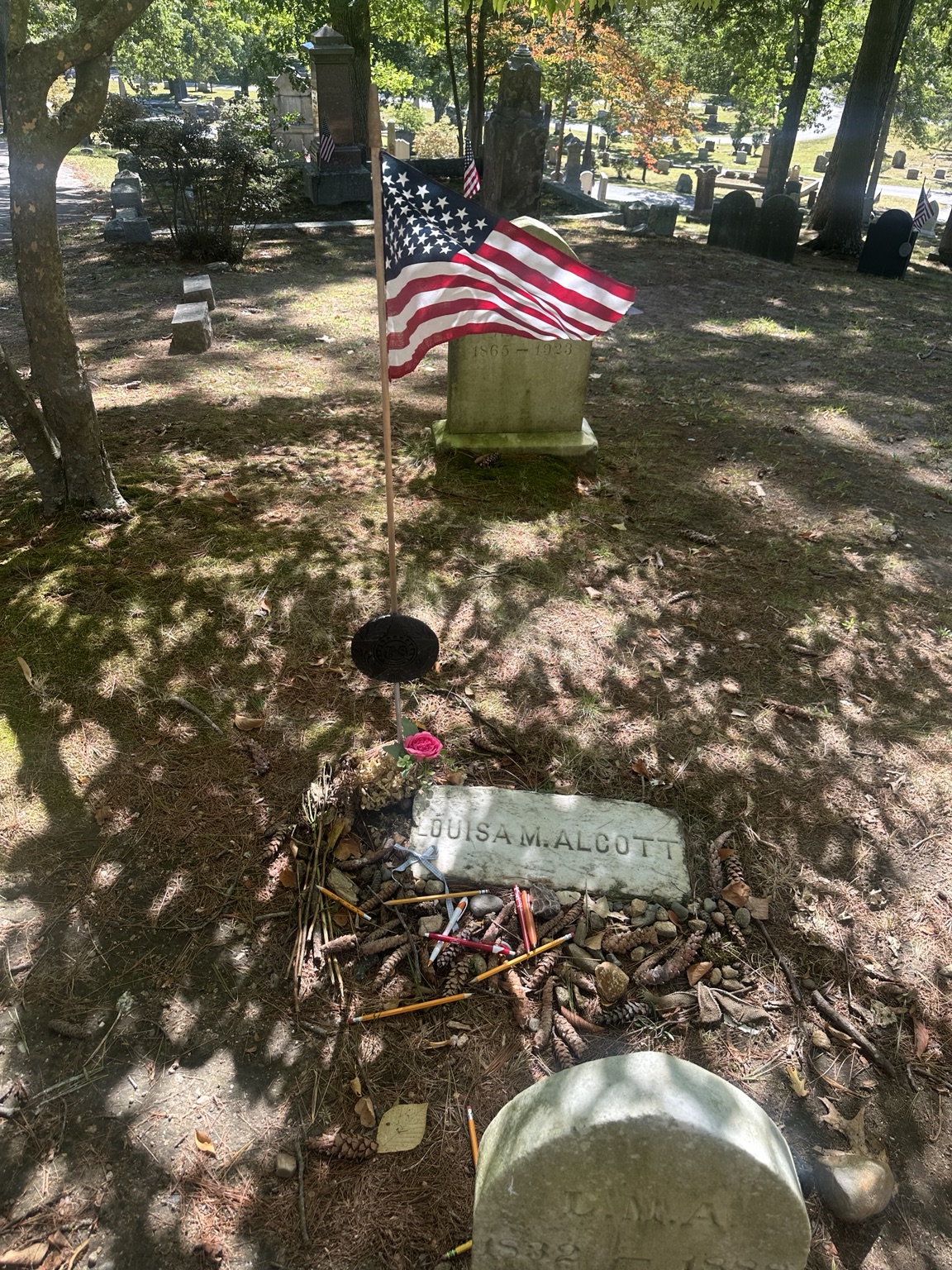
Louisa May Alcott’s grave on a wooded slope, with pencils, pinecones, a pink rose and an American flag in dappled sunlight.
Louisa May Alcott’s resting place, from our own visit to Authors’ Ridge.

I’m a writer. Dad is a professor. We’d lived here for three years.

And somehow, we had never made the trek to Authors’ Ridge.

On paper, we were very well qualified to have done this already.

But a funny thing happens when you live near somewhere people travel to see: it becomes the place you can visit any time. And “any time” has a way of slipping behind everything that actually has a date on the calendar.

So, for a little while this fall, we became tourists in our own backyard. Our date took us to Authors’ Ridge in Concord’s Sleepy Hollow Cemetery, where Louisa May Alcott, Henry David Thoreau, Nathaniel Hawthorne and Ralph Waldo Emerson are buried. Familiar names, suddenly attached to very small, very human places. About the writers and the cemetery.

The things people leave behind

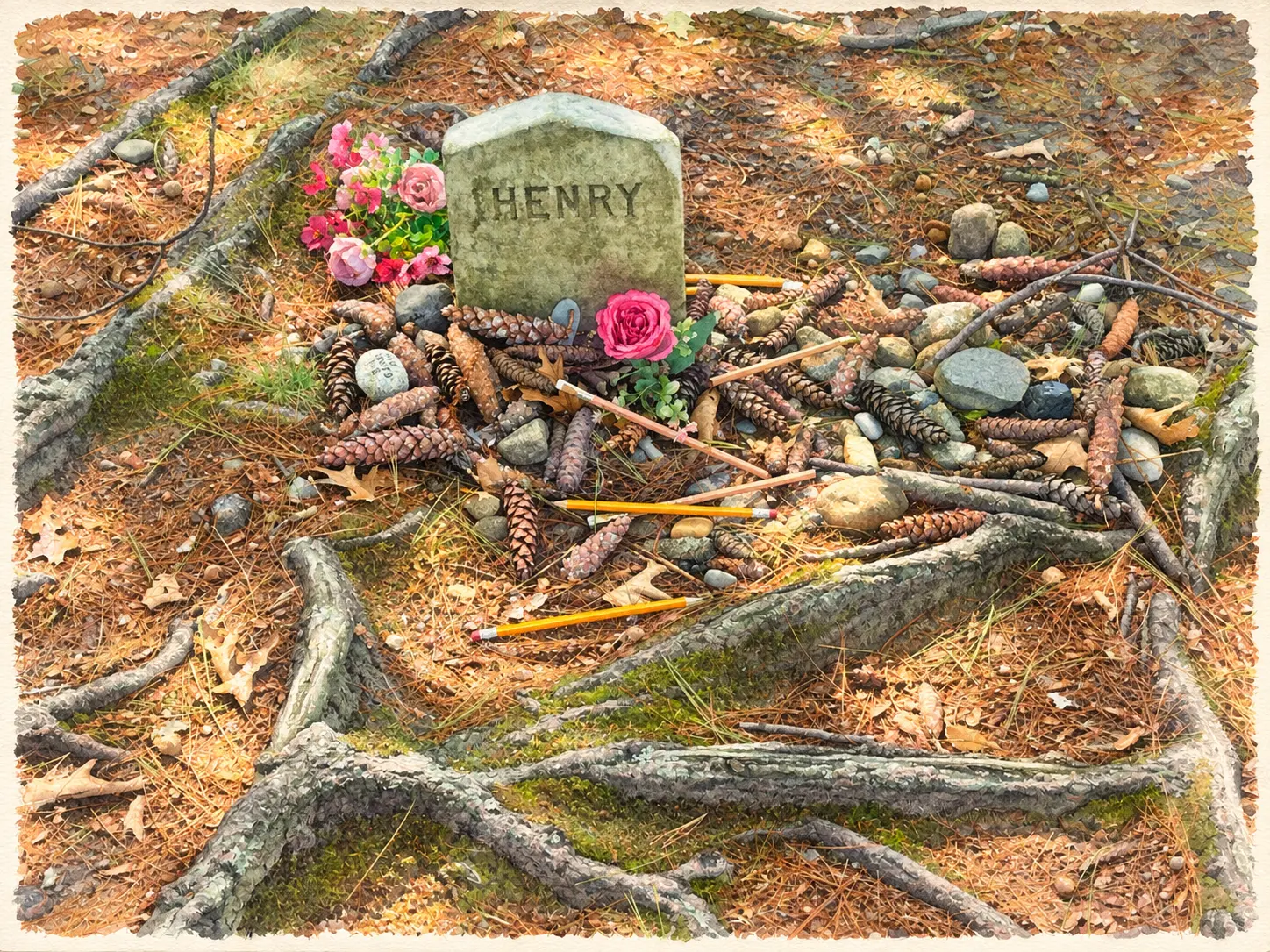
Look closely at the photographs. Around Louisa May Alcott’s marker are pencils, pinecones, stones and a pink rose. At Thoreau’s, more pencils lie among the roots and needles, beneath a little stone that simply says Henry.

I find the pencils especially moving. Such ordinary things, brought to the graves of people whose words have lasted so long. To me, they look like small thank-yous: your work reached someone. Someone is still reading.

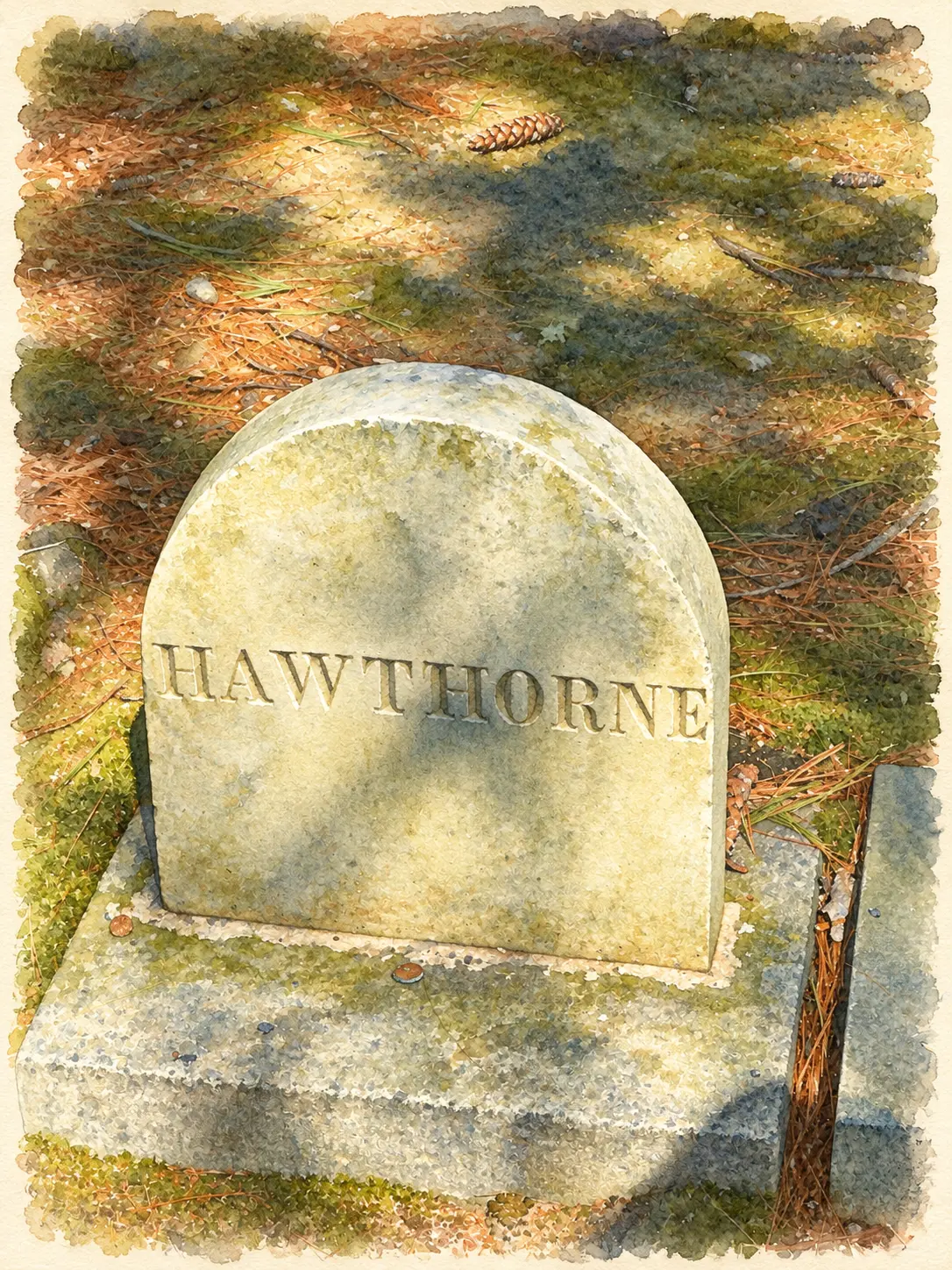
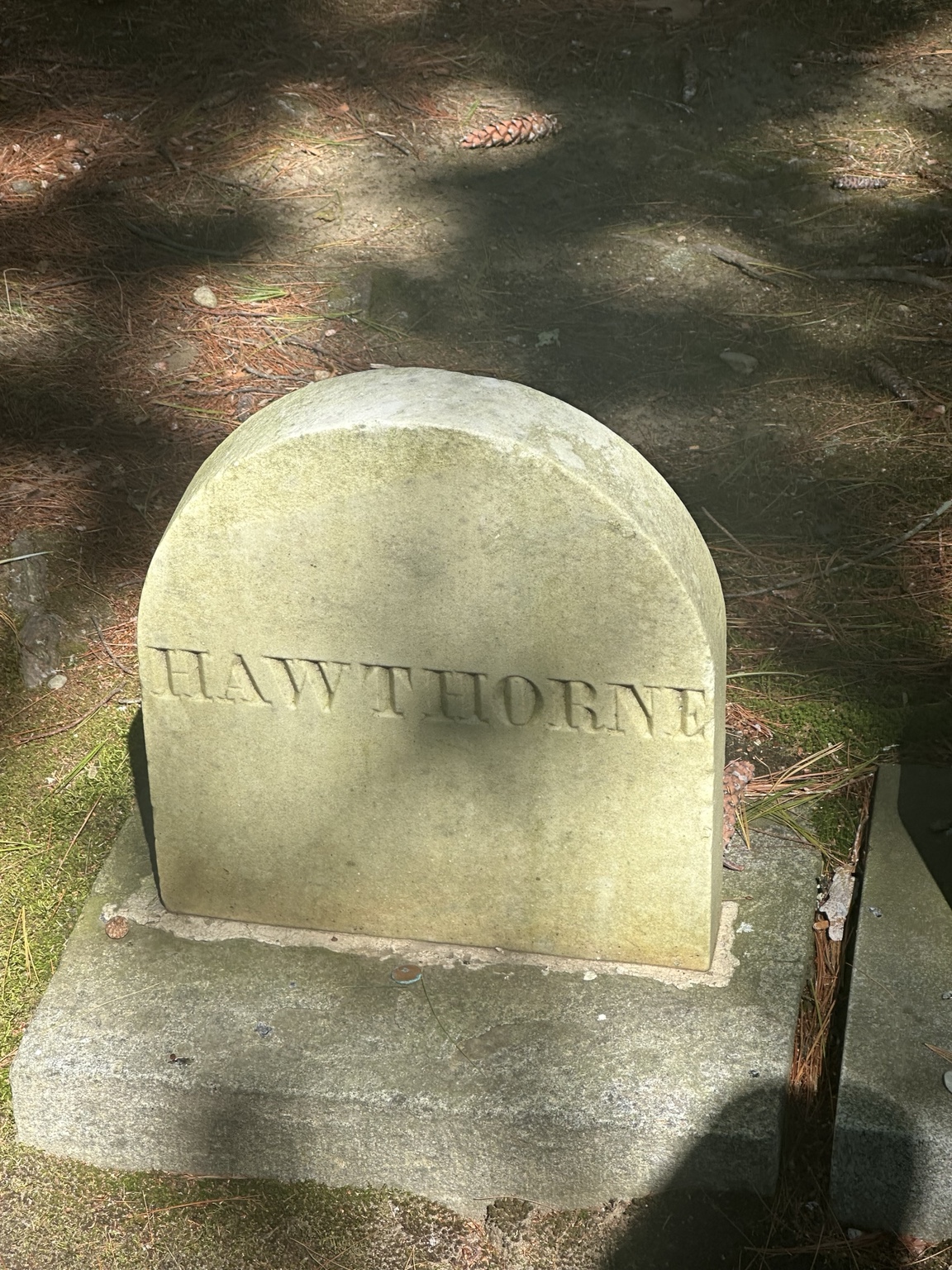
Hawthorne’s marker has its own quiet simplicity. A rounded stone, a surname, sunlight and shadow. You can know a name for years and still feel differently about it when you stand in front of it, outdoors, at the scale of a person.
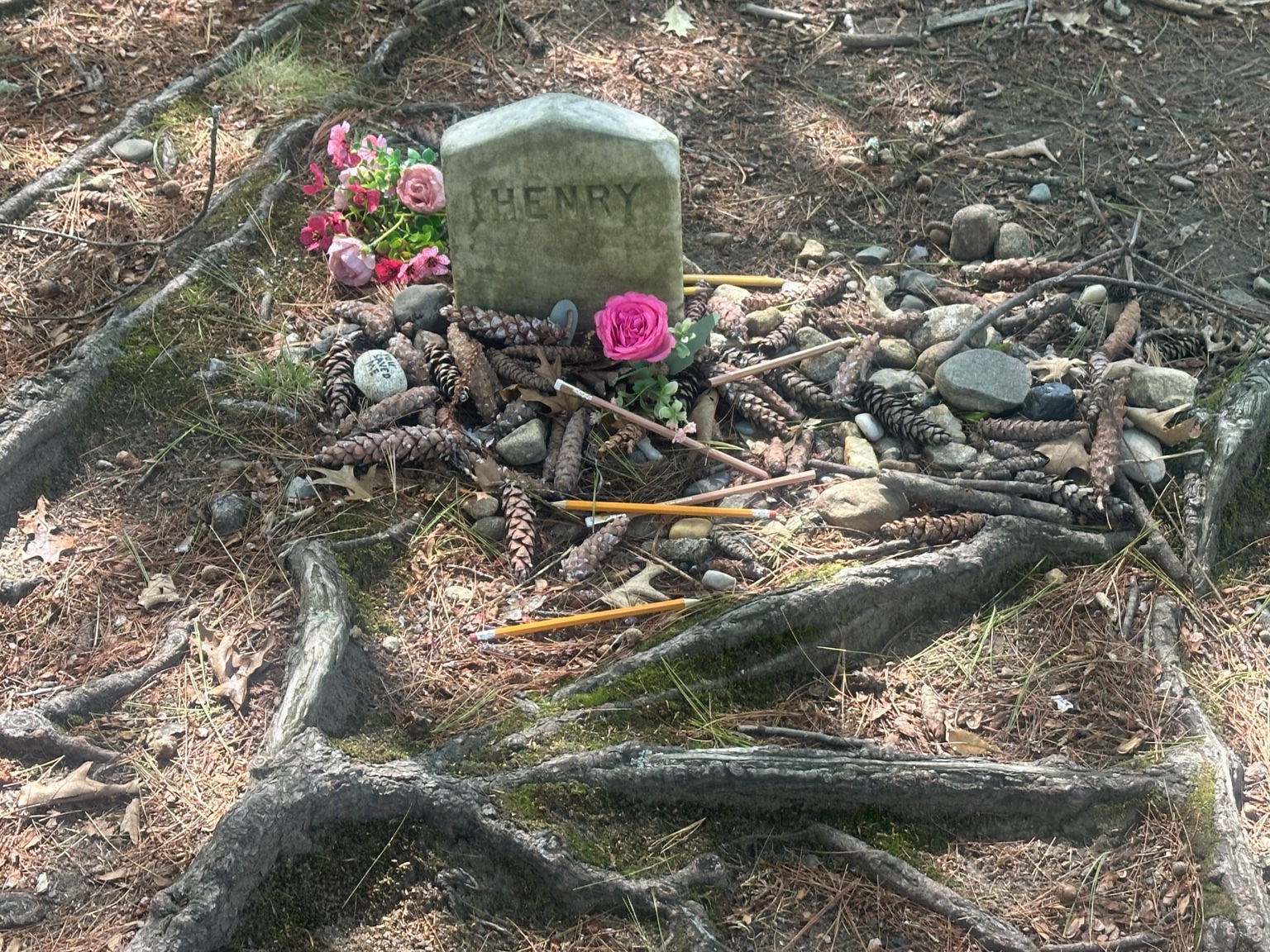
Thoreau’s small marker engraved Henry, surrounded by pink flowers, pencils, pinecones, pebbles and exposed tree roots.
Henry: a small marker, tree roots, and the things visitors have left.
A simple rounded gravestone engraved Hawthorne, with tree shadows falling over its pale surface.
Hawthorne, in patches of sun and shade.

In our photographs, the trees still hold plenty of green. A little gold is beginning to show. The ground has its own autumn palette: brown needles, gray stone, moss, a bright flower. There is enough to look at before you read a single name.

Before the graves, there were evening walks

One of my favorite pieces of this place’s history is that the writers knew it as a place to walk. The National Park Service records that Emerson, Thoreau, and Nathaniel and Sophia Hawthorne enjoyed evening walks in Sleepy Hollow before it became a cemetery.

Before these woods held their graves, they held their evening walks.

That makes a date here feel part of a much older habit: going outside together, looking around, letting a familiar landscape give you something to think about.

Sleepy Hollow was dedicated on September 29, 1855, with an address by Emerson. Landscape architects Horace William Shaler Cleveland and Robert Morris Copeland planned paths and drives around the natural shape of the land, respecting its trees and plants. The Concord Free Public Library’s dedication exhibit describes that approach—and notes that the place already carried the name Sleepy Hollow before it was a burial ground.

It belongs to the nineteenth-century tradition of rural or garden cemeteries, where landscape and remembrance meet. The winding roads and wooded setting are part of the history you have come to see. Read about the landscape.

A little more of the neighborhood

Concord’s history reaches much further back than the writers. The Concord Museum identifies the area as the original homelands of the Nipmuc, Massachusett and Pawtucket tribal nations, and recognizes Indigenous people’s continuing connection to this land.

Nearby, the North Bridge holds another chapter: the battle of April 19, 1775. A visit to Concord can open onto many histories. Authors’ Ridge gave us plenty to notice on its own.

Something lovely, close to home

A date like this makes room for the people we are as well as the people we look after. I’m still a writer. Dad is still someone who loves ideas. And we are still two people who can go somewhere together and find things worth noticing.

I like that the visit didn’t need to be elaborate to be worth remembering. A nearby place, a little curiosity, a few photographs. There is a particular pleasure in finally doing the thing that has been waiting so close to home.

Three years was a long time to get around to it. I’m glad we finally went.
From the photographs

A little autumn sketchbook

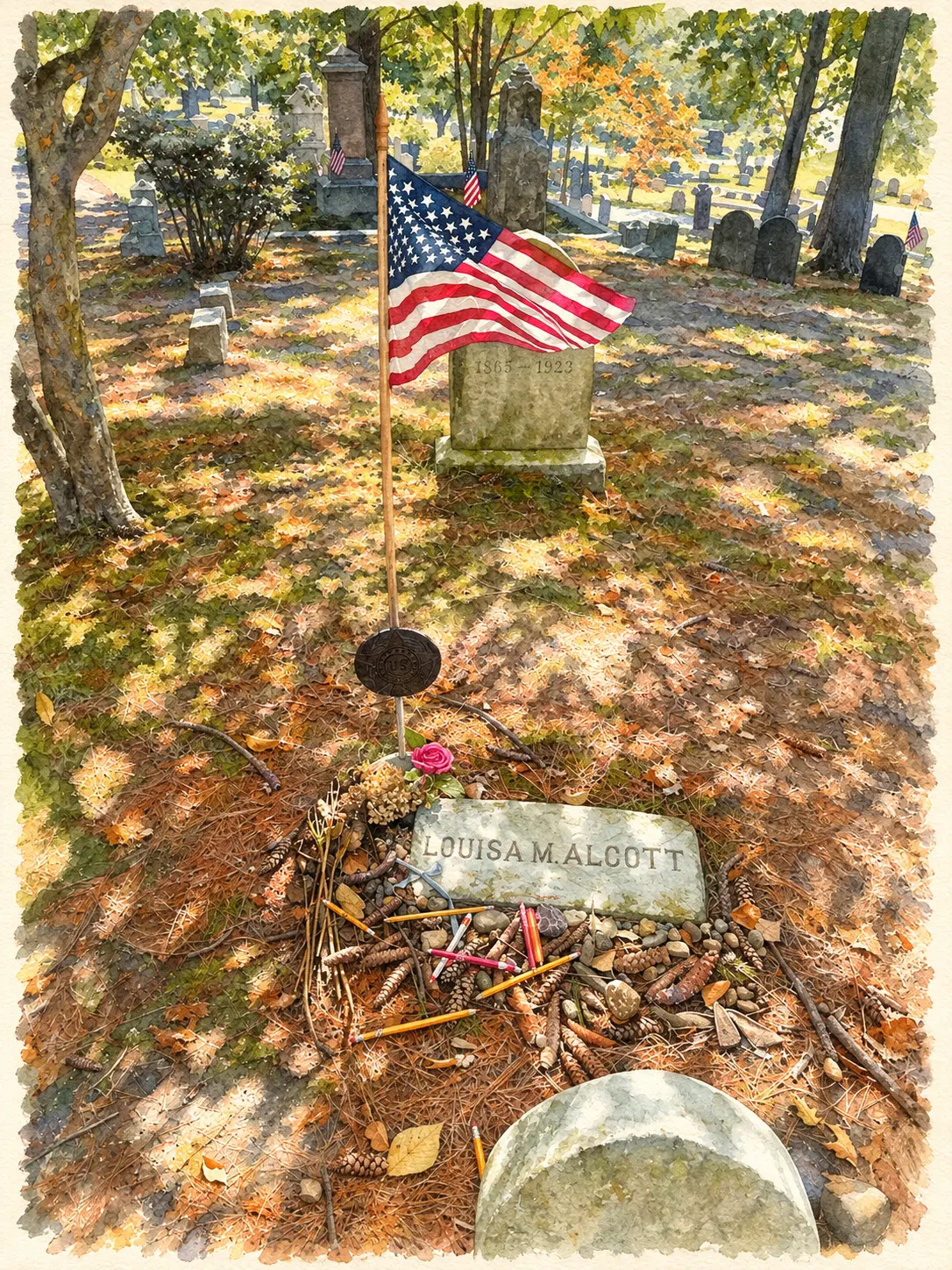
Three watercolor interpretations of our visit. The photographs above show the actual places; these companion illustrations hold their color and feeling. About our editorial artwork.

Watercolor illustration of Louisa May Alcott’s grave, its flag, pencils and rose beneath sunlit trees.
Louisa May Alcott · Original editorial illustration
Watercolor illustration of Thoreau’s Henry marker, pink flowers, pencils, pinecones and curving tree roots.
Henry David Thoreau · Original editorial illustration
Watercolor illustration of Hawthorne’s rounded gravestone in warm sunlight and soft tree shadows.
Nathaniel Hawthorne · Original editorial illustration

For a visit of your own

Find the hillside—and your way around

This map locates the destination. It does not verify a step-free route, a usable parking space, or the condition of a cemetery path.

Inside Sleepy Hollow

Authors’ Ridge, Sleepy Hollow Cemetery
Bedford Street, Concord, Massachusetts.

The town’s detailed map labels the gates, internal roads, paths and graves of interest. Open it before you arrive, and use current signs on the grounds.

Open the official cemetery map (PDF) ↗

Arriving by car: the town’s visitor brochure directs drivers approaching from the center toward the second Bedford Street gate and notes parking near Authors’ Ridge. That brochure is older; follow current gate and parking signs and keep the roads clear. Town visitor guide.

For current gate, parking or route questions, call the Cemetery Office: 978-318-3233.

The practical details left in

Plan a visit that works for you

Cost: free to visit, according to Visit Concord.

Hours: town rules list daily opening at 7 a.m. and closing at dusk or 8 p.m., whichever comes first, weather permitting. In mid-fall, plan around the earlier dusk. Check current town rules and posted gate signs.

Mobility, ground surfaces & the approach

Authors’ Ridge is a hillside visit. The official tourism listing says the approach includes an incline. Our photographs show exposed roots, bare earth and pine needles around some markers. The town’s cemetery master plan acknowledges accessibility challenges from the hills and limited parking.

Parking nearer the ridge may shorten the approach; it does not establish a level or step-free route to every grave. If you use a wheelchair, walker or stroller, or need to limit walking, ask the Cemetery Office about your specific route and parking needs before going: 978-318-3233. After rain, take extra care around wet leaves and roots.

Restrooms & a place to regroup

Plan a restroom stop in Concord Center. The Concord Visitor Center at 58 Main Street lists public bathrooms, and its access guide identifies accessible restrooms inside. Those two pages currently give different opening hours for the facilities. If access to a particular restroom matters to your visit, call 978-318-3061 to confirm availability.

Sensory needs, pacing & family planning

The photos here are from our date. They do not establish how this outing would work for another person or at another time. Outdoor space can still include other visitors, vehicles and maintenance sounds. If predictability helps, preview the photographs and town map, choose a short first stop, and keep an easy return to the car in your plan.

If visiting with someone who uses AAC or other communication supports, keep their usual communication available and make room for “break,” “leave” and “all done.” For a date that depends on someone else covering care, our caregiver handover guide offers a place to put the essentials.

Being a thoughtful visitor

Sleepy Hollow is an active cemetery. Give funerals and people visiting loved ones plenty of space. Follow the roads and paths, respect the grave lots, and leave markers and existing objects undisturbed. The town prohibits gravestone rubbing. See the cemetery rules for the full visiting and photography guidance.

Keep the rest of the date simple

For readers who want a second stop, Concord Bookshop at 65 Main Street continues the literary theme. Main Streets Market & Cafe at 42 Main Street is another nearby option for coffee or a meal. Check each business’s current hours and any access arrangements you need. These are ideas for extending your own outing.

Or let the cemetery visit be the whole date. One nearby place, finally seen together, can be plenty.

History, maps & visitor sources

Visitor information checked October 21, 2026. Our photographs and account describe our own visit; historical and practical information comes from the sources below. This is a family account, not a complete access audit. The watercolor illustrations were created afterward from our photographs and do not document routes or facilities.

Pictures to take with you

The writers & their books

Four writers, four books. Point to someone you want to talk about, choose a book to explore, or use the pictures while you revisit the story. Open any card to change its label, or print the whole set.

Louisa May Alcott
Little Women

Louisa May Alcott wrote Little Women. A novel about four sisters growing up.

Henry David Thoreau
Walden

Henry David Thoreau wrote Walden. Nonfiction about living simply near Walden Pond.

Nathaniel Hawthorne
The Scarlet Letter

Nathaniel Hawthorne wrote The Scarlet Letter. A novel about a woman facing judgment in her community.

Ralph Waldo Emerson
Nature

Ralph Waldo Emerson wrote Nature. A book-length essay about people and the natural world.

Keep the person’s usual communication available. These are independent picture communication cards, not official PECS® materials.

About the portraits, book pictures & sources

The cards pair historical portraits with original book symbols created for this story. The book pictures identify the titles; they do not reproduce the covers of a particular edition. This set was prepared after our visit.

Book information: Library of Congress: Little Women, Walden and The Scarlet Letter; Concord Free Public Library: Emerson’s Nature. Original book symbols by An AUsome Life.

Share a nearby fall date

Pass along this Concord story and its practical visit notes to someone who enjoys a little history with their autumn walk.